The Realistic Timeline for Returning to Exercise Postpartum (Not the Instagram Version)
Quick Answer: The standard 6-week clearance means cleared to begin gentle activity, not cleared to resume your pre-pregnancy routine — a more realistic timeline involves gradual rebuilding over 3-6+ months, with core and pelvic floor function, not the calendar, as the actual pacing guide.
The “6 weeks and you’re cleared” framing leaves out just how gradual the actual rebuilding process is meant to be.

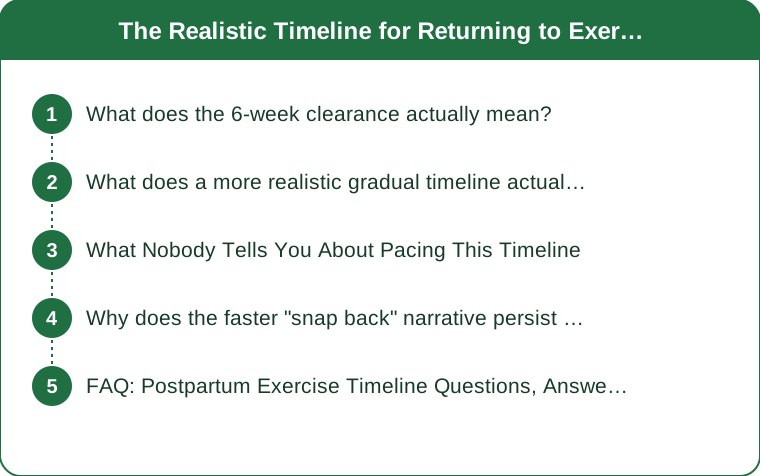
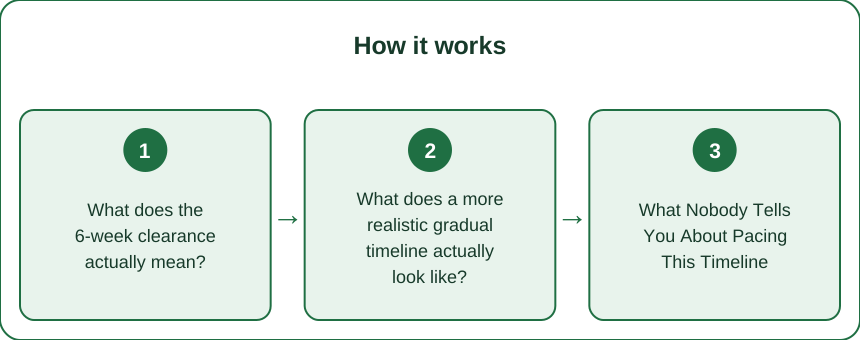
What does the 6-week clearance actually mean?
The typical 6-week postpartum checkup clearance confirms that tissue has healed enough for general activity to begin — it’s a baseline safety checkpoint, not a signal that your body has regained pre-pregnancy strength, core function, or pelvic floor capacity. Many providers now explicitly frame this as “cleared to start gently,” though that nuance doesn’t always come through in general messaging.
Jumping straight back into pre-pregnancy intensity at week 6 skips the gradual rebuilding phase most physical therapists specializing in postpartum recovery consider essential, regardless of how strong you may feel.
What does a more realistic gradual timeline actually look like?
Weeks 6-12: gentle walking, breathing and pelvic floor reconnection work, light bodyweight movement — building the foundation, not the workout itself. Months 3-6: gradual reintroduction of light resistance training and low-impact cardio, guided by how the body responds (no doming, leaking, or pain) rather than a fixed calendar date.
6+ months: for many people, this is when higher-impact activity (running, jumping, heavier lifting) becomes appropriate — later than commonly assumed, and genuinely individual based on delivery type, core/pelvic floor recovery, and overall healing.

What Nobody Tells You About Pacing This Timeline
Function should guide pacing more than the calendar — symptoms like leaking during exercise, a visible doming/coning at the abdomen, or pelvic pressure are signals to scale back regardless of how many weeks postpartum you are, even well past the 6-week mark. Many postpartum specialists consider these signs more informative than any specific week-number milestone.
Also underrated: a C-section birth typically needs a somewhat longer and more gradual runway than vaginal delivery, given the abdominal surgical recovery involved — the general timeline shifts later, not because of weakness, but genuine tissue healing time.
Why does the faster “snap back” narrative persist despite this?
Social media and some fitness marketing prominently feature outlier fast-recovery stories, which get disproportionate visibility precisely because they’re unusual, not representative. This skews public perception of what “normal” postpartum recovery pacing looks like, and can create unnecessary pressure or guilt for the far more common gradual timeline.
A slower, function-guided return isn’t a sign of doing something wrong — for most people, it’s simply what genuine tissue and core/pelvic floor recovery actually requires.
FAQ: Postpartum Exercise Timeline Questions, Answered
Is it normal to still not feel ready for pre-pregnancy workouts at 6 months?
Yes, entirely normal — many people need 6-12 months or longer for full core and pelvic floor function to rebuild, especially with more significant diastasis recti or a C-section recovery.
Should I see a specialist before resuming exercise, or is the 6-week clearance enough?
A postpartum-specialized pelvic floor physical therapist assessment, even for those who feel fine, can catch subtle issues a general 6-week checkup doesn’t specifically screen for.
What symptoms mean I should scale back even if I’m past 6 weeks?
Leaking, pelvic pressure or heaviness, abdominal doming, or pain are all signals to reduce intensity and consult a provider, regardless of how much time has passed since delivery. This is general information, not medical advice.
TL;DR:
- The 6-week clearance means cleared to begin gently, not cleared for pre-pregnancy intensity
- A realistic timeline gradually rebuilds over 3-6+ months, guided by function, not the calendar
- Leaking, doming, or pelvic pressure are signals to scale back at any point postpartum
- C-section recovery typically needs a longer, more gradual runway than vaginal delivery. This is general information, not medical advice.
See It in Motion
Seen here: Maternity Capris with Side Pockets — shop it on bubblelime.com
Keep Reading
This article is for general informational and styling purposes only. Fit, sizing, and product availability may vary.
