Why Postpartum Recovery Is Measured in Load, Not Weeks
Quick Answer: The six-week check confirms that healing is progressing, not that you are ready for the exercise you did before. A better framework is symptom-guided load progression: increase activity gradually, and treat leaking, heaviness, doming of the abdomen or pain as signals to reduce and rebuild rather than push through. Walking, breathing-coordinated core work and gradual loading in that order will get most people further in three months than an early return to running.
Six weeks arrives, you get the all-clear, and nothing about how you feel matches the permission you were just given.
That gap is normal, and there is a much more useful way to think about it.

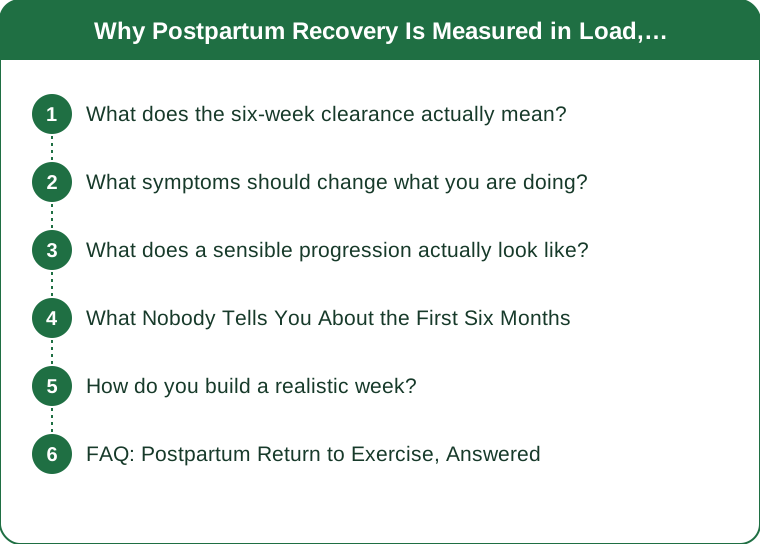
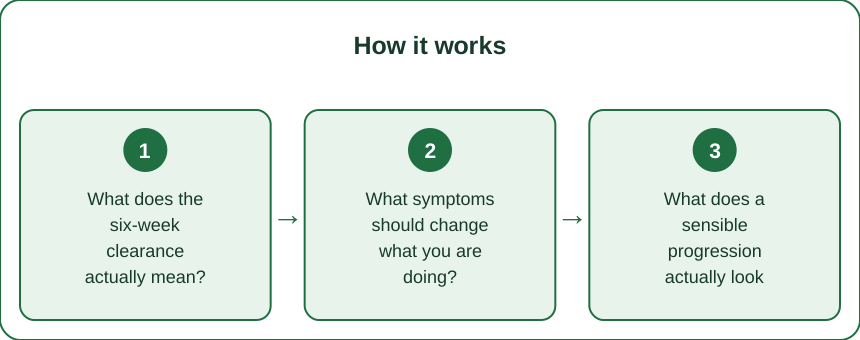
What does the six-week clearance actually mean?
It confirms that acute healing is progressing normally - that the uterus is involuting, that incisions or tears are healing, and that there are no complications requiring attention.
It is not an assessment of load tolerance. A standard postpartum check rarely includes any evaluation of pelvic floor function, abdominal wall integrity or movement capacity under load.
Tissue remodelling continues for many months. Connective tissue strength recovers over a much longer timeline than the visible healing that the six-week check assesses.
Relaxin and other pregnancy hormones remain elevated for a period after birth, and longer while breastfeeding, which affects joint stability.
Caesarean recovery involves healing through multiple abdominal layers, and while the skin closes early, deeper layers take substantially longer.
Which is why symptom-guided progression is the better framework. The calendar tells you when to start considering more; your symptoms tell you whether more is appropriate today.
What symptoms should change what you are doing?
Leaking urine during an activity means that activity is currently beyond your pelvic floor’s capacity. It is common and it is not something to work through - it is information about load.
A sensation of heaviness, dragging or bulging in the pelvis is a signal to stop that activity and seek pelvic health physiotherapy assessment.
Doming or coning along the midline during a movement means the abdominal wall is not managing the pressure. Reduce the load or change the movement.
Increased or changed bleeding after activity is a reason to reduce activity and, if it persists, to seek advice.
Pain anywhere - pelvis, back, scar, hips - is a stop signal, not a scale to push through.
Symptoms often appear later in the day rather than during the activity, so evaluate the evening as well as the session.
And any of these persisting warrants a pelvic health physiotherapy referral, which is effective, underused, and available in most places. This is general information, not medical advice.
What does a sensible progression actually look like?
Start with walking, progressed by minutes rather than miles. Add five minutes at a time and hold for several days before adding more. This is the single most reliable postpartum progression there is.
Add breathing-coordinated core work early - exhale on effort, gentle pelvic floor and deep abdominal engagement at roughly 30 percent, no breath-holding.
Add loaded movement before impact. Squats, hip hinges, rows and presses with light weight are more appropriate at three months than running is, and they build the capacity that running requires.
Return to running is commonly suggested no earlier than around 12 weeks, and only when you can hop, jog in place, single-leg balance and perform basic strength work without symptoms.
Load the whole body, not just the core. Carrying an infant car seat is a heavy asymmetric lift performed dozens of times a week, and grip, back and shoulder strength are what make it manageable.
Expect progress to be non-linear, particularly with disrupted sleep. A bad week is a bad week, not a reversal.
And use the perceived-exertion scale rather than a program’s prescribed intensity, because your recovery capacity varies enormously day to day in this period.

What Nobody Tells You About the First Six Months
Sleep deprivation limits recovery more than exercise programming does. Tissue repair, hormonal regulation and load tolerance all depend on sleep, and no training plan compensates for its absence. Doing less on bad nights is a strategy, not a failure.
Shoe size frequently changes and often does not change back. Ligament laxity plus weight distribution during pregnancy alters foot structure, and buying shoes that fit now is worth more than waiting to fit back into old ones.
Rib cage and bra size change on a different timeline than everything else, shifting again when feeding patterns change. Measuring rather than assuming saves money and discomfort.
Abdominal separation is normal during pregnancy and narrows for most people over months. What matters functionally is whether the midline can generate tension, not the gap width in centimetres.
The car seat is the heaviest lift of early postpartum, typically 20 to 30 pounds carried one-handed at arm’s length. Training a suitcase carry directly prepares you for it, and almost no postpartum program mentions it.
Pelvic health physiotherapy is standard care in several countries and optional in others, which means many people simply never learn it exists. It is worth asking for.
And comparison is uniquely useless here, because recovery varies with birth type, complications, feeding, sleep, support and prior fitness - six variables that differ for everyone.
How do you build a realistic week?
Two or three short structured sessions plus daily walking is a genuinely effective week in the first few months.
Fifteen to twenty minutes is a real session. Waiting for an hour of uninterrupted time is how people do nothing for six months.
Split sessions across the day if that is what fits - three ten-minute blocks work.
Prioritise in this order: walking, breathing and core coordination, then loaded strength, then impact. Skipping ahead is the most common cause of setbacks.
Keep one note of symptoms - leaking, heaviness, doming, pain - alongside what you did. Patterns become obvious within two weeks and the note is what makes them visible.
Get assessed if anything persists. Pelvic health physiotherapy resolves a large share of these issues and does not require symptoms to be severe to be worth doing.
And judge progress by what you can do without symptoms, not by how close you are to your pre-pregnancy numbers. This is general information, not medical advice.
FAQ: Postpartum Return to Exercise, Answered
Does the six-week clearance mean I can do anything?
No. It confirms healing is progressing. Load tolerance is a separate question, and it is answered by whether an activity produces symptoms rather than by the date.
When can I start running again?
Common guidance suggests no earlier than about 12 weeks, and only once you can hop, jog in place and do basic strength work without leaking, heaviness or pain. Many people need longer, which is normal.
Is leaking during exercise normal postpartum?
It is common, which is not the same as normal or acceptable. It indicates the load exceeds current pelvic floor capacity and is a strong reason to see a pelvic health physiotherapist.
What is doming and does it matter?
Doming is a ridge or bulge along the midline during effort, indicating the abdominal wall is not managing pressure well at that load. Reduce the load or change the movement; it is a useful, immediate signal.
Does breastfeeding affect exercise recovery?
It affects energy needs, hydration and hormone levels, and joint laxity can persist longer. It does not prevent exercise, but it does mean paying more attention to fuelling and fluids.
How long until I feel like myself again?
Highly variable, and often longer than people expect - many report six to twelve months for full function. Sleep, birth type and support all shift the timeline substantially. This is general information, not medical advice.
TL;DR:
- The six-week check confirms healing, not readiness for load - it assesses a different question entirely.
- Progress by symptoms: leaking, heaviness, doming, pain or changed bleeding all mean reduce and rebuild.
- Order of operations: walking by minutes, then breathing-coordinated core, then loaded strength, then impact.
- Running is commonly suggested no earlier than about 12 weeks and only when symptom-free under simpler load.
- Sleep deprivation limits recovery more than any programming choice - doing less on bad nights is strategy.
- Train the suitcase carry; the infant car seat is the heaviest lift of early postpartum and no program mentions it.
Ask for a pelvic health physiotherapy referral if anything persists. This is general information, not medical advice.
See It in Motion
Seen here: Maternity Capris with Side Pockets — shop it on bubblelime.com
Keep Reading
This article is for general informational and styling purposes only. Fit, sizing, and product availability may vary.
