Why Postpartum Compression Needs Change Meaningfully Week by Week
Quick Answer: Postpartum swelling, incision healing (for a C-section), and core and pelvic floor recovery all follow different timelines, so a single compression garment optimized for the first week or two — often firmer and more focused on incision support — tends to feel increasingly wrong by weeks four to six, when swelling has reduced and the focus shifts toward gentler, more mobility-friendly core support; planning for at least two different compression stages, rather than one garment for the entire recovery, better matches what the body actually needs at each point.
A compression garment that felt perfect in week one and increasingly uncomfortable by week four isn’t a sign of a bad purchase — it’s a sign recovery itself has moved into a genuinely different phase with different needs.

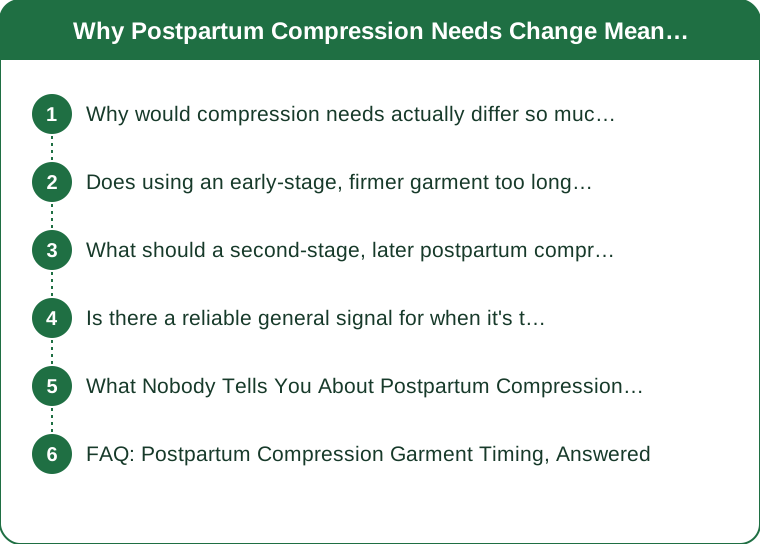
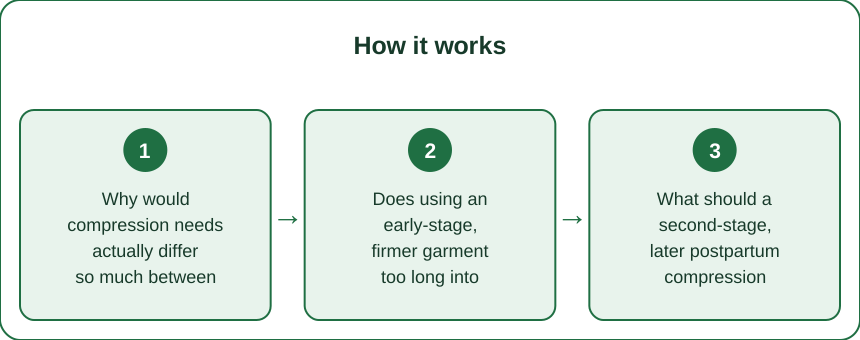
Why would compression needs actually differ so much between early and later postpartum weeks?
In the first one to two weeks, postpartum swelling (edema) is often at its most pronounced, and for a C-section specifically, incision support and gentle abdominal stabilization are a priority, which favors a firmer, more structured garment. By weeks four to six, swelling has typically reduced substantially, incision healing has progressed, and the priority shifts toward gentle core support that accommodates increasing mobility and activity, which a firm, structured early-stage garment doesn’t flex well with.
Does using an early-stage, firmer garment too long into recovery actually cause any problems?
It can, particularly as activity level increases — a garment designed for very limited early movement can feel restrictive and uncomfortable once someone is walking more, returning to light activity, or simply moving around more freely, and continuing to wear it out of habit rather than switching to a more mobility-friendly option often gets misread as “compression garments just aren’t for me” rather than recognized as a timing mismatch.
What should a second-stage, later postpartum compression garment actually prioritize?
Gentler, more breathable compression that supports core engagement during increasing activity, rather than firm, rigid structure meant for near-total stillness, is generally more appropriate for the four-to-six-week-and-beyond stage. Garments marketed for “postpartum recovery” broadly can span a wide range of firmness, so checking the specific intended use stage (early recovery versus return-to-activity) matters more than the general “postpartum” label alone.

Is there a reliable general signal for when it’s time to transition from an early-stage to a later-stage garment?
Noticing the early-stage garment starting to feel restrictive during normal daily movement, rather than supportive, is a practical, individual signal worth paying attention to, more reliable than a fixed universal timeline, since healing pace genuinely varies by individual and by delivery type. For anyone recovering from a C-section specifically, checking with a healthcare provider about incision healing status alongside this comfort signal is a reasonable additional guide.
What Nobody Tells You About Postpartum Compression Timing
Plus-size-specific compression garments sometimes aren’t designed with this same two-stage distinction in mind, since the category has historically had fewer options overall, meaning it can take more deliberate searching to find both an appropriately firm early-stage option and a genuinely comfortable, mobility-friendly later-stage option in extended sizing — budgeting time for this search, rather than assuming the first option found will work for the entire recovery, avoids a frustrating mismatch.
FAQ: Postpartum Compression Garment Timing, Answered
Is it necessary to buy two separate garments, or can one work for the entire recovery?
While some adjustable garments can span a wider range, many people find two distinct garments — one firmer for early recovery, one gentler for later stages — provides a meaningfully better fit at each point than trying to make one garment work throughout.
Does this same two-stage timing consideration apply to vaginal delivery recovery, not just C-section?
Yes, though the incision-support component is specific to C-section recovery — swelling reduction and the shift toward more mobility-friendly support still follow a similar general timeline for vaginal delivery recovery.
Should a healthcare provider be consulted before starting or changing postpartum compression garment use?
Yes, particularly for anyone with a C-section or other complications — a healthcare provider can confirm what’s appropriate for individual healing progress. This is general information, not medical advice.
TL;DR:
- Early postpartum compression needs (weeks one to two) favor firmer, incision- and swelling-focused support
- By weeks four to six, reduced swelling and increasing activity call for gentler, more mobility-friendly compression
- A garment feeling restrictive during normal movement is a practical signal it’s time to transition stages
- Planning for two distinct compression garments better matches recovery’s actual, changing timeline
Postpartum compression needs genuinely shift as recovery progresses, and planning for that shift — rather than expecting one garment to work throughout — leads to a far more comfortable recovery experience. This is general information, not medical advice.
See It in Motion
Seen here: Maternity Capris with Side Pockets — shop it on bubblelime.com
Keep Reading
This article is for general informational and styling purposes only. Fit, sizing, and product availability may vary.
