Why Postpartum Progress Is Easier to See in Endurance Than in Strength
Quick Answer: Postpartum recovery restores cardiovascular capacity and everyday endurance considerably faster than it restores maximal strength, because blood volume, cardiac output, and aerobic conditioning respond within weeks while connective tissue remodeling and neuromuscular control of the trunk take months. Tracking only weights makes it look like nothing is improving. Tracking endurance markers — walking distance, stairs, carrying time, recovery between tasks — shows the progress that is actually occurring.
Choosing the right measurement is not a consolation prize. It is how you avoid concluding that a recovery going normally is going badly.
This is general information, not medical advice. Follow your own clinician’s guidance on returning to exercise.

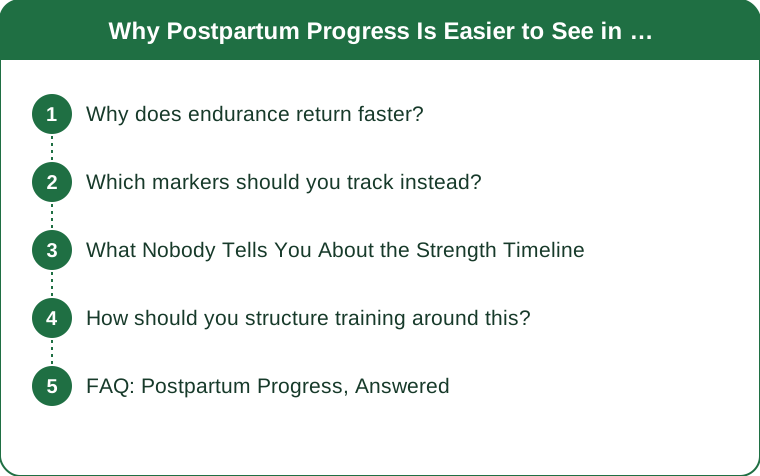
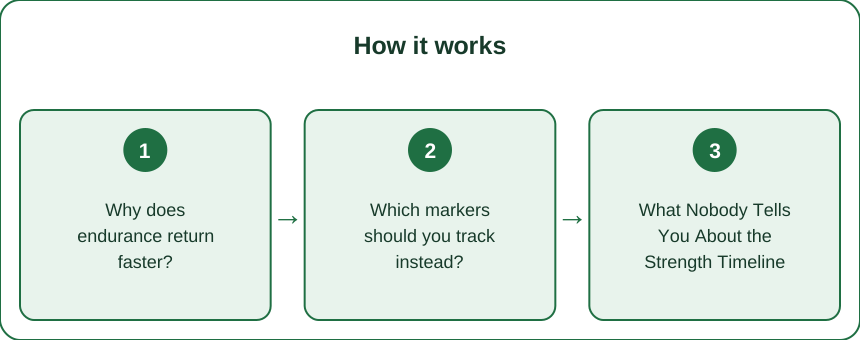
Why does endurance return faster?
Because the systems involved recover on different timescales.
Cardiovascular capacity rebounds quickly. Pregnancy increases blood volume substantially, and while that normalizes postpartum, the underlying aerobic conditioning responds to training within weeks. Heart rate at a given walking pace, recovery between efforts, and sustainable duration all improve on a fast timeline.
Connective tissue takes months. The abdominal wall, the linea alba, the pelvic floor, and the ligaments loosened by relaxin during pregnancy remodel over a period measured in months, not weeks. Relaxin levels fall after birth but tissue changes lag considerably behind, and this remains true for many months when breastfeeding.
Trunk neuromuscular control has to be relearned. The coordination between diaphragm, abdominals, and pelvic floor is disrupted by pregnancy and does not simply switch back on. Maximal strength expression depends heavily on that coordination, which is why heavy lifting feels disproportionately hard even when the muscle itself is capable.
So a plateau in the weights is often not a plateau in recovery. It is one system moving at its own pace while another moves faster, and the weights are measuring the slow one.
There is also the practical context: fragmented sleep meaningfully suppresses maximal strength expression while affecting steady-state endurance considerably less.
Which markers should you track instead?
Ones that reflect the systems currently changing.
Continuous walking time. How long you can walk at a comfortable pace without needing to stop. This improves noticeably week to week in early recovery and is the single most sensitive marker available.
Stairs without stopping. Flights climbed continuously, and how you feel at the top. Concrete, repeatable, and part of daily life already.
Carry time. How long you can carry your baby, a car seat, or a bag of shopping before setting it down. This one improves fast and is directly relevant to daily function.
Recovery between tasks. How long after climbing the stairs before your breathing settles. This improves before any of the above and is the earliest visible sign of progress.
Total daily step count, if you track it. A rising baseline of general activity often precedes any improvement in structured exercise and is a genuine indicator of capacity.
Write down one number for each of these once a week. The reason it works is that these markers move on a weekly timescale while strength markers move on a monthly one — so weekly tracking produces visible progress rather than a flat line.
And track symptoms alongside, particularly heaviness, leaking, or abdominal doming. Those are the signals that determine whether to progress or hold, and they matter more than any performance number.

What Nobody Tells You About the Strength Timeline
The six-week clearance is a starting line, not a finish line. It is clearance to begin progressive return, not confirmation that tissue healing is complete. Most people are told the first and hear the second.
Strength often returns in a step rather than a slope. Weeks of apparent stagnation followed by a sudden jump is a common pattern, and it reflects the trunk coordination coming back online rather than the muscle suddenly growing.
Breathing pattern is usually the limiting factor before muscle is. Many postpartum plateaus resolve when the person relearns to exhale on effort rather than bracing and holding. It is a coordination fix, not a strength fix.
Comparison to your pre-pregnancy numbers is the least useful thing you can do. Those numbers were produced by a different body in different circumstances with different sleep. They will likely be reached again, and they are a terrible weekly reference point.
Doming or coning of the abdomen during an exercise is a signal to regress that exercise, not to push through. It indicates the load exceeds what the abdominal wall can currently manage, and continuing tends to slow the remodeling you are waiting on.
How should you structure training around this?
Build the fast-recovering system while patiently rebuilding the slow one.
Make walking the foundation. Progressive walking — increasing duration before intensity — builds the endurance base, is well tolerated, and produces visible weekly progress. Adding five minutes a week is a realistic and effective progression.
Train strength for control, not load, in the early months. Bodyweight and light-load work with attention to breathing and trunk coordination. The goal in this phase is restoring the pattern, and the load can be added later much faster than the pattern can.
Prioritize carries and single-leg work. Both are highly relevant to daily life with a baby, both load the trunk in a way that builds coordination, and both improve visibly on a useful timescale.
Expect the timeline to be months. A commonly cited framework is around 12 weeks to return to structured training and considerably longer — often six months to a year — for a full return to previous strength. That is a normal recovery, not a slow one.
See a pelvic health physiotherapist if you can. An assessment identifies whether the limiting factor is pelvic floor, abdominal wall, or general conditioning, and that answer changes the program entirely. It is the highest-value single step available in postpartum return to exercise.
This is general information, not medical advice. Bleeding, pain, leaking, or a feeling of heaviness are reasons to consult a clinician rather than to adjust the program alone.
FAQ: Postpartum Progress, Answered
How long until strength comes back?
Highly individual. Many people see meaningful strength return between three and six months with consistent training, and a full return often takes longer. Breastfeeding, sleep, and delivery type all affect the timeline.
Does breastfeeding slow strength recovery?
It affects the hormonal environment and adds significant energy demand, both of which can slow progress. It does not prevent it, and adequate energy intake matters more than most people are told.
Should I be doing anything for diastasis recti?
If you have a gap, the priority is generating tension across it rather than closing it by measurement. That is best guided by a professional assessment, since the right progression depends on what the tissue currently does under load.
This is general information, not medical advice.
TL;DR:
- Cardiovascular capacity returns in weeks; connective tissue and trunk coordination take months.
- Tracking only weights makes a normal recovery look like a stalled one.
- Track walking time, stairs, carry time, and recovery between tasks — these move weekly.
- Train control before load, make walking the foundation, and see a pelvic health physiotherapist if available.
Write down four endurance numbers this week and check them again next week. That comparison shows you the recovery that the barbell was hiding.
This is general information, not medical advice.
See It in Motion
Seen here: Maternity Capris with Side Pockets — shop it on bubblelime.com
Keep Reading
This article is for general informational and styling purposes only. Fit, sizing, and product availability may vary.
