Why Your Wrists Hurt Postpartum and Which Carrying Position Changes It
Quick Answer: Postpartum wrist and thumb pain usually comes from repeated lifting with the wrists bent and the thumbs extended — the natural scoop-under-the-armpits position — many dozens of times a day. Tendon irritation at the base of the thumb is the common pattern. Lifting with flat wrists and scooping from underneath the body, rather than using the thumbs as hooks, removes most of the load.
Nobody warned you that your wrists would be the part that hurt.
But picking up your own baby now sends a sharp line of pain from your thumb into your forearm.

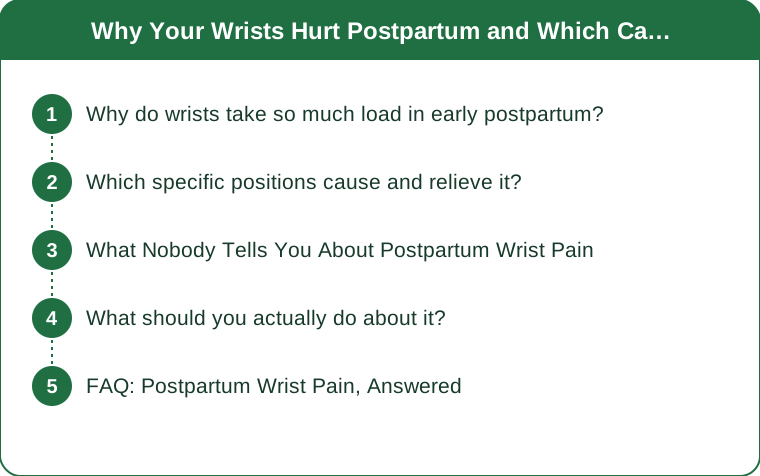
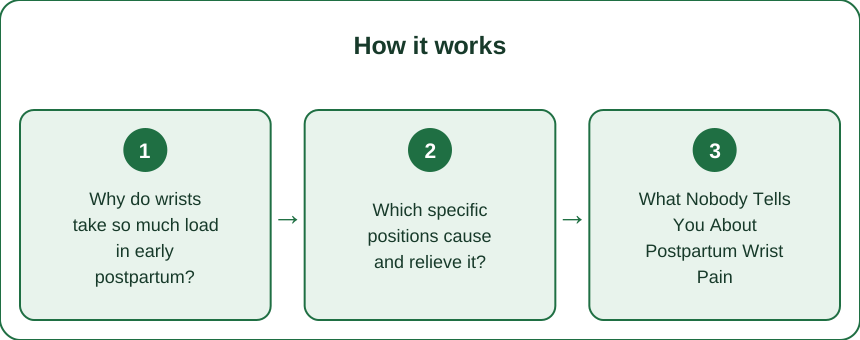
Why do wrists take so much load in early postpartum?
Because of the number of lifts and the position they happen in.
The volume is enormous. Picking up an infant happens dozens of times a day, every day, in a way that no other activity in your life has ever required.
The default lift is the worst position for the wrist. Scooping under the arms with hands upright means the wrists are bent backward and the thumbs are extended and taking load. That combination puts maximum stress on the tendons at the base of the thumb.
The load grows steadily. An infant gains weight continuously while the lifting position stays the same, so the demand increases weekly without any change in what you are doing.
Hormonal changes affect tendons and ligaments. Relaxin and other pregnancy-related hormonal shifts increase tissue laxity, and levels do not immediately return to baseline after birth — particularly while breastfeeding. Looser supporting structures mean tendons work harder.
Fluid retention can add compression. Postpartum swelling can contribute to compression in the wrist, which is why some people experience numbness and tingling alongside the pain.
Which specific positions cause and relieve it?
The difference between the common lift and a better one is significant and easy to adopt.
The problem position: hands under the armpits, wrists bent back, thumbs up. This is the instinctive lift and it loads the thumb tendons directly. It is also the position most often demonstrated, which is why nearly everyone does it.
The better position: scoop from underneath with flat wrists. One hand under the head and neck, one under the bottom, forearms doing the work and wrists in a neutral straight line. It requires getting closer to the baby, which is the main adjustment.
Keep thumbs alongside the fingers, not sticking out. The thumb should not act as a hook. Treating your hand as a flat platform rather than a claw removes the specific tendon load.
Get closer before you lift. Lifting at arm’s length multiplies the load on every joint. Step in, bring the baby to your chest, then stand — the same principle as any other lift.
Alternate sides deliberately. Most people carry on one preferred side, which concentrates all of the load on one wrist. Switching every feed or every carry roughly halves the load on each.

What Nobody Tells You About Postpartum Wrist Pain
It is common enough to have a nickname, which tells you how routine it is. Tendon irritation at the base of the thumb is frequent enough postpartum that it is widely recognized, and it is not a sign you are doing anything wrong or being weak about it.
Car seats are worse than babies. The infant car seat carried by its handle puts the wrist in a loaded, bent position with far more weight than the baby alone. If your wrists hurt, the car seat carry is often the largest single contributor, and carrying it against your body with both arms is a meaningful improvement.
Phone use while feeding adds up. Holding a phone in one hand for long stretches during feeds, in an awkward wrist position, contributes real load at exactly the time the tendons are already irritated. A phone stand or propping arrangement helps more than it sounds like it would.
It often peaks around three to five months. The baby is substantially heavier but not yet mobile enough to help, and the cumulative load has been building. Many people assume it will keep worsening — it usually improves as the baby gets more able to be moved differently.
A brace works but only if it is the right kind. A thumb spica splint that immobilizes the thumb and wrist is the type used for this specific problem. A general wrist wrap that leaves the thumb free does not address the tendons actually involved.
What should you actually do about it?
Change the mechanics first, then support, then get it assessed if it persists.
Switch to the flat-wrist scoop for every lift. This is the highest-value change and it is free. It feels awkward for two days and then becomes automatic.
Carry the car seat against your body, not by the handle. Both arms, held close. It is more awkward to walk with and dramatically better for your wrists.
Use pillows and props for feeding. Supporting the baby’s weight on a pillow rather than in your hands removes a large amount of sustained load, and sustained holds contribute as much as the lifts do.
Consider a thumb spica splint for nights. Wearing it while sleeping gives the tendons an uninterrupted rest period without interfering with daytime function.
Get it assessed if it persists past a few weeks of these changes, or if there is numbness, tingling, or weakness in the hand. Postpartum wrist pain is common and generally responds well to treatment, and a physical therapist or doctor can confirm what is actually irritated rather than leaving you to guess. This is general information, not medical advice.
FAQ: Postpartum Wrist Pain, Answered
Will it go away on its own?
Often, as the mechanics change and hormonal levels settle — but it can persist for many months if the loading position does not change. The mechanics are what you control, and changing them shortens the timeline considerably.
Can I still exercise with it?
Generally yes, avoiding movements that load a bent wrist — push-ups and front-loaded holds are the usual problems. Working on machines or using forearm-supported variations lets you keep training. Anything that reproduces the sharp thumb-base pain should be modified.
Does it happen more with a bigger baby?
Load matters, so a heavier baby increases the demand. But volume of lifts and the position used matter more than the weight itself — someone lifting a lighter baby forty times a day with bent wrists will typically have more trouble than someone lifting a heavier baby with good mechanics.
TL;DR:
- Repeated lifting with bent wrists and extended thumbs is the main cause, not weakness
- Scoop from underneath with flat wrists and thumbs alongside the fingers, not hooked
- The infant car seat carried by its handle is often the single biggest contributor
- Alternate carrying sides, use pillows for feeds, and consider a thumb spica splint at night
- Numbness, tingling, or pain persisting past a few weeks of changes is worth getting assessed
This one is worth mentioning to other people, because almost nobody is warned about it and almost everybody experiences some version of it. The fix is mostly a change in how you pick up, and it is available today.
See It in Motion
Seen here: Maternity Capris with Side Pockets — shop it on bubblelime.com
Keep Reading
This article is for general informational and styling purposes only. Fit, sizing, and product availability may vary.
