Why Postpartum Shoe Size Changes and Nobody Warns You About It
Quick Answer: Many people find their feet are permanently larger after pregnancy, usually by up to about half a size, because relaxin loosens the ligaments in the foot and the added load flattens the arch, which lengthens and widens the foot. The change is most common after a first pregnancy. Separately, temporary postpartum swelling can make feet larger for weeks. This matters because returning to walking in shoes that no longer fit is a direct route to foot pain, and because buying new shoes too early risks fitting to swelling rather than to your actual size.
You put on the trainers you wore before, ready to start walking again, and they are wrong. Tight across the width, short at the toe, and uncomfortable in a way you cannot place.
Almost nobody is told this happens. This blog has covered how compression needs change week by week and how walking should progress by minutes rather than miles, and footwear is the piece of equipment most likely to have changed underneath you.

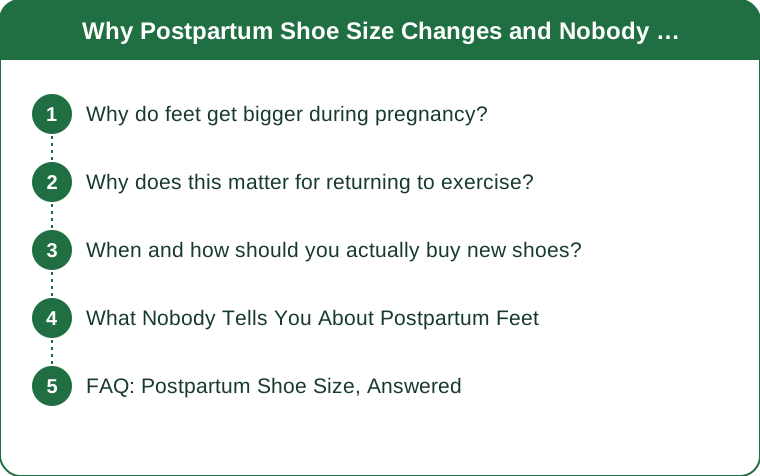
Why do feet get bigger during pregnancy?
Two mechanisms, one temporary and one often permanent.
Relaxin loosens ligaments throughout the body. This hormone increases through pregnancy to allow the pelvis to accommodate birth, and it does not act selectively. Ligaments everywhere become more lax, including the ones holding the arch of the foot together.
Added load flattens the arch. With looser ligaments and additional body weight carried at the front of the body, the arch of the foot lowers. A lower arch means a longer and wider foot, because the same amount of foot is spread over more ground.
Research has measured this. Studies following people through pregnancy have found measurable decreases in arch height and increases in foot length, with the changes persisting after birth for a substantial proportion, most commonly after a first pregnancy. Second and subsequent pregnancies produce less additional change.
Which explains why it is often permanent. Once the arch has lowered and the ligaments have settled at a new length, it does not necessarily return. Many people find they are permanently up to about half a size longer and noticeably wider.
Separately, there is temporary swelling. Fluid retention in late pregnancy and in the early postpartum weeks makes feet larger in a way that does resolve. This can take several weeks, and it can be substantial. The two effects overlap, which is why judging your size at week two is unreliable.
Width changes more than length for many people, which matters because most shoe shopping is done by length. A foot that is the same length and a full width wider will feel wrong in every pair you own, and the number on the box will not explain it.
Why does this matter for returning to exercise?
Because shoes that no longer fit are a direct cause of the problems people attribute to being unfit.
Too-small shoes cause specific and predictable problems. Toe pain, black toenails, blisters, forefoot burning, and a general reluctance to walk further. All of these are commonly interpreted as the body not being ready, when they are a fit problem.
A lowered arch changes what support you need. A shoe that was appropriate for your previous foot may provide the wrong support for a flatter one. Some people who never needed arch support find they do now.
Postpartum walking is where this surfaces. Walking is the standard and correct first return to activity, and it is also the activity that puts sustained repetitive load on the foot. This blog has covered progressing by minutes rather than miles, and the shoes need to be right for that progression to work.
Foot pain is common postpartum for several overlapping reasons. Changed foot structure, altered gait from carrying a baby on one hip, the residual effects of relaxin which persists for a period after birth, and simply doing more standing and walking than before. Plantar fasciitis and general arch pain are both frequently reported.
And the pelvic floor connection is real. How your foot strikes the ground affects the load travelling up the chain. Persistent foot pain that changes your gait is not isolated to the foot, particularly during a period when pelvic floor recovery is ongoing.
If foot pain persists, a podiatrist or physiotherapist is the right person to see. Postpartum foot pain is common and treatable, and pushing through it while the fit is wrong will not resolve it. This is general information, not medical advice.

When and how should you actually buy new shoes?
Timing matters, and the fitting process matters more than the brand.
Wait for the swelling to settle before buying properly. Fluid retention resolves over weeks. Buying at week two risks fitting to swollen feet and ending up with shoes that are too large once it resolves. If you need something immediately, buy one cheap comfortable pair to get through it, and do the proper fitting later.
Get measured rather than assuming. Both feet, standing, with weight on them. Many people have not had their feet measured since childhood, and a postpartum measurement is genuinely useful information. Foot length and width are both worth knowing.
Measure at the end of the day. Feet are larger later in the day for everyone, and more so postpartum. A shoe fitted first thing will be tight by evening.
Prioritise width. This is the change people most often miss because shoe sizing is dominated by length. If shoes feel tight across the ball of the foot but the length seems fine, you need a wider fitting rather than a longer shoe. Going up a length to solve a width problem creates heel slip and toe bruising.
Leave a thumb’s width at the toe. Standard fitting advice and it matters more now, because feet may still be changing and because walking causes the foot to slide forward.
Consider arch support you did not need before. If your arch has genuinely lowered, a supportive insole or a shoe with more structure may be appropriate. This is worth a conversation with a podiatrist rather than guessing, particularly if there is pain.
Expect to replace rather than to stretch. Shoes can be stretched slightly and it will not accommodate a genuinely changed foot. If a favourite pair no longer fits, it no longer fits.
And check what you wear at home. Most postpartum time is spent indoors, often barefoot or in unsupportive slippers, doing a lot of standing and carrying. Supportive indoor footwear is an unglamorous and genuinely useful purchase.
What Nobody Tells You About Postpartum Feet
It happens most after the first pregnancy. Research suggests the biggest change occurs with a first pregnancy, with less additional change in subsequent ones. So someone expecting a second baby is unlikely to see the same magnitude of change again.
Not everyone experiences it. A meaningful proportion of people see no lasting change. It is common, not universal, and it is worth measuring rather than assuming either way.
Relaxin persists after birth. Levels drop after delivery, and ligament laxity does not return to baseline immediately, and some research suggests breastfeeding may extend the period. This is one reason a graded return to impact activity is recommended rather than an immediate one.
Carrying a baby changes your gait asymmetrically. Habitually carrying on one hip shifts your loading pattern, which shows up in the foot, the hip, and the lower back. Alternating sides is a small habit worth building deliberately.
Shoe size can change again with weight change. Foot length and width respond to load, so weight change in either direction across the postpartum period can shift the fit again. Judging a permanent size at three months may be early.
The compression logic applies here too. This blog has covered how postpartum compression feels different in the morning than the evening, and feet follow the same pattern. Shoes that fit at 9am and hurt at 6pm are usually not too small, they are being judged at two different foot volumes.
Seasonal note: the shift into autumn means moving from open shoes that accommodated a changed foot without complaint into closed shoes that do not. A lot of people discover this change in October rather than in July, which is why it can seem to appear suddenly months after birth.
FAQ: Postpartum Shoe Size, Answered
Do feet permanently get bigger after pregnancy?
Often, yes. Relaxin loosens the ligaments supporting the arch and added load flattens it, making the foot longer and wider. Studies have found this persists for a substantial proportion of people, most commonly after a first pregnancy.
How long should I wait before buying new shoes postpartum?
Wait for fluid swelling to settle, which takes several weeks, before doing a proper fitting. Buy one comfortable pair to get through the interim if you need to, rather than investing in shoes fitted to swollen feet.
Why do my old trainers hurt even though the length seems right?
Most likely width. Feet frequently widen more than they lengthen, and shoe sizing is dominated by length, so a width change goes unnoticed. Look for a wider fitting rather than a longer shoe.
Is postpartum foot pain normal?
It is common, from a flattened arch, lingering ligament laxity, and more standing and carrying. Common does not mean you should push through it. A podiatrist or physiotherapist can help. This is general information, not medical advice.
TL;DR:
- Relaxin loosens the ligaments supporting the arch, and added load flattens it, making feet longer and wider, often permanently.
- The change is largest after a first pregnancy and does not affect everyone. Temporary swelling overlaps with it for the first several weeks.
- Width changes more than length for many people, which is why shoes feel wrong even when the size seems right.
- Wait for swelling to settle, get both feet measured at the end of the day, and prioritise width over going up a length.
If your return-to-walking plan is stalling because your feet hurt, measure your feet before you conclude anything about your fitness.
See It in Motion
Seen here: Maternity Capris with Side Pockets — shop it on bubblelime.com
Keep Reading
This article is for general informational and styling purposes only. Fit, sizing, and product availability may vary.
