Why Postpartum Sizing Changes Faster Than Any Other Time and How to Shop for It
Quick Answer: Postpartum body change is rapid and non-linear: fluid shifts resolve over the first couple of weeks, the uterus involutes over roughly six weeks, ribcage and hip width may not fully return, and breast size fluctuates with feeding for months. Buying a full wardrobe at any single point almost guarantees waste. The approach that works is a small number of adjustable pieces now, nothing bought for a future size, and replacing by category rather than all at once.
You bought leggings in week three. By week seven they were loose in one place and tight in another.
Then you bought more, and the same thing happened.
Nothing is wrong. The timeline just moves faster than shopping does.

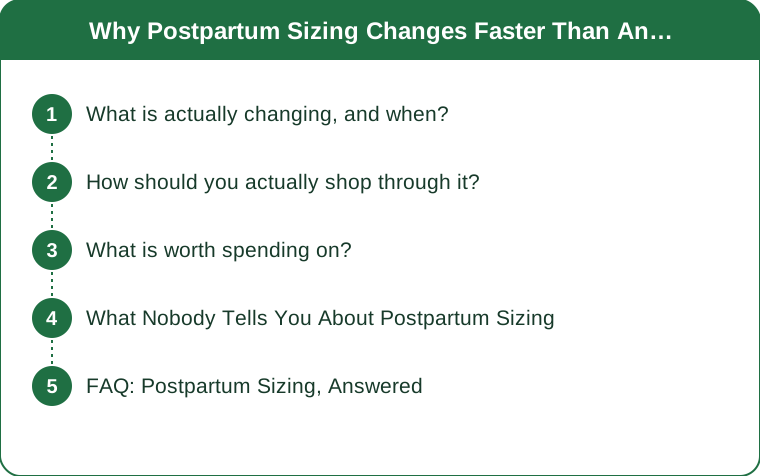
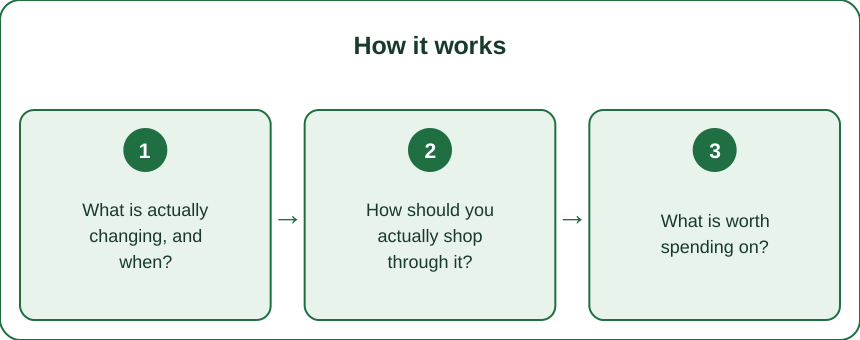
What is actually changing, and when?
Several different processes on different clocks, which is why nothing settles evenly.
Fluid shifts resolve in the first one to two weeks. Significant fluid retention from pregnancy and labour clears early, and it can change measurements noticeably within days.
The uterus involutes over about six weeks. Abdominal circumference changes substantially through this window, which is why waistbands are the most volatile measurement.
The ribcage may stay wider. Ribs expand during pregnancy and do not always return fully. Band size for bras is affected long-term for many people.
Hip width can change permanently. Ligament and structural changes mean hip measurements sometimes settle at a new number, which affects trousers more than tops.
Breast size fluctuates with feeding. If breastfeeding, size changes across the day and across months, and again at weaning. Bras bought at week three are frequently wrong by week ten.
Feet change too. Foot length and width can increase permanently, and it commonly goes unnoticed until shoes are uncomfortable for months.
Timeline reality. Most people find things stabilise somewhere between six months and a year, and the endpoint is often a different shape rather than a different number.
How should you actually shop through it?
Buy adjustable, buy few, and buy for now.
Prioritise adjustability. Wrap tops, drawstrings, ribbed and high-recovery fabrics, and anything with a wide size tolerance. These stay usable across a bigger range than fitted pieces.
Buy for today, never for a future size. Aspirational sizing is the most common postpartum shopping mistake and the most reliably wasteful.
Two of what you wear daily beats six of what you might. A small rotation you actually like is worth more than a full wardrobe of compromises.
Replace by category, not all at once. Bras when bras stop working, bottoms when bottoms do. They change on different timelines.
Get professionally fitted for bras at least twice. Once at around six to eight weeks, and again after weaning or when feeding stabilises. Band and cup change independently.
Keep some larger pieces. Do not clear out the bigger sizes in month two. Bodies fluctuate, and having options removes a source of daily frustration.
Seasonal note: a baby born in spring means the postpartum year crosses two full wardrobe seasons. Buying autumn pieces at the six-week mark is buying for a body you will not have by November. Buy minimal transitional layers now and the real autumn pieces in October.

What is worth spending on?
A short list, because most of it is genuinely temporary.
Bras, without question. They are worn constantly, they affect comfort and posture directly, and the fit window is narrow. This is where the money goes.
Two pairs of well-fitting bottoms. High-rise, soft waistband, good recovery fabric. Worth spending on because you wear them daily.
One outer layer that fits now. A jacket or cardigan you feel good in changes how everything under it feels.
Not worth spending on: anything fitted through the waist, anything bought as motivation, and a full set of matching pieces.
Recovery-specific garments have a defined window. Compression wear has a real role in the early weeks, but it is a phase, not a wardrobe. Buy for the weeks you will use it.
Second-hand is genuinely sensible here. Postpartum clothing is worn briefly by definition, so the resale market is full of barely-used pieces, and passing yours on afterwards is straightforward.
What Nobody Tells You About Postpartum Sizing
Your size can differ between top and bottom by more than before. Ribcage and hip changes are independent, and buying sets becomes less practical for a while.
Shoe size change is common and rarely mentioned. If your shoes have been uncomfortable since the birth, get remeasured rather than assuming it is swelling.
Waistband placement matters more than size. After a caesarean particularly, where the band sits determines comfort far more than what number is on the label.
Compression feels different at different weeks. What is supportive at week two can be uncomfortable at week six as swelling resolves. Adjustable is better than fixed.
Nothing about the timeline is a performance measure. Six weeks, six months and a year are all normal points for things to settle, and where you land is not a reflection of effort.
And the practical one: put the too-small clothes somewhere you cannot see them. Daily visual comparison to a previous size is a genuine source of low mood in a period where sleep is already doing enough damage.
FAQ: Postpartum Sizing, Answered
When will my size stabilise?
Commonly somewhere between six months and a year, and often at a different shape rather than a different number.
When should I get fitted for a bra?
Around six to eight weeks, and again when feeding stabilises or after weaning. Band and cup change separately.
Should I keep my pre-pregnancy clothes?
Keep them, store them out of sight. Some will fit again, some will not, and daily reminders are not useful right now.
Is compression wear necessary?
It has a role in the early weeks for comfort and support for many people. Follow guidance from your midwife or doctor rather than buying by marketing claims.
Why do my hips measure differently?
Structural and ligamentous changes in pregnancy can persist. It is common and it is not a problem to solve.
When should I ask a professional?
Ongoing pain, significant asymmetry, leaking or abdominal separation concerns are all worth raising with your doctor or a pelvic health physiotherapist. This is general information, not medical advice.
TL;DR:
- Postpartum change is fast and uneven: fluid in weeks, uterus over six, ribcage and hips possibly permanent.
- Buy adjustable, few, and for today — never for a future size.
- Replace by category as each stops working, not all at once.
- Spend on bras and two pairs of bottoms; treat compression wear as a defined phase.
- Stabilisation commonly lands between six months and a year, often at a new shape.
Buy two things that fit today. It is more useful than eight that might fit in spring.
See It in Motion
Seen here: Maternity Capris with Side Pockets — shop it on bubblelime.com
Keep Reading
This article is for general informational and styling purposes only. Fit, sizing, and product availability may vary.
