Why Postpartum Walking Should Progress by Minutes, Not Miles
Quick Answer: Distance doesn’t account for pace, terrain, carrying load, or how much recovery time your body actually got — all of which vary enormously postpartum. Time-based progression naturally self-regulates for those variables, which is why most pelvic health guidance frames early return-to-activity in minutes rather than miles.
Two miles at week six sounds like a reasonable target. Two miles pushing a stroller uphill on four hours of broken sleep is a completely different event from two miles flat and unloaded — and your body scores them differently even though the app doesn’t.

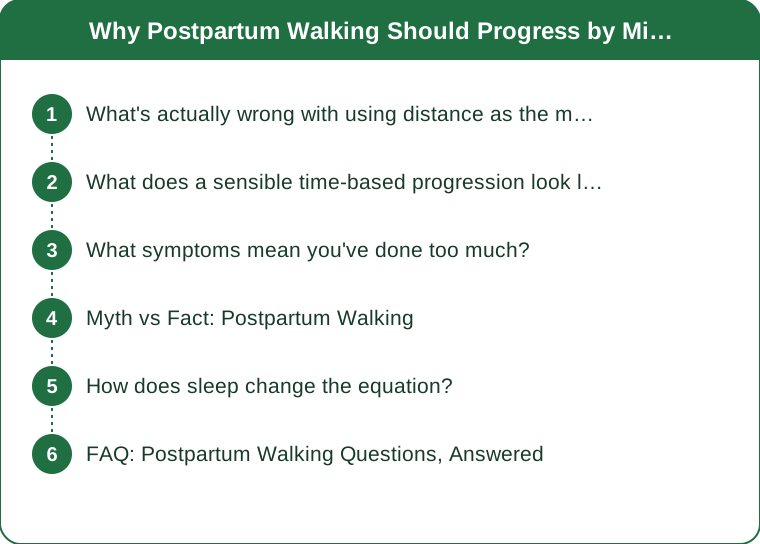
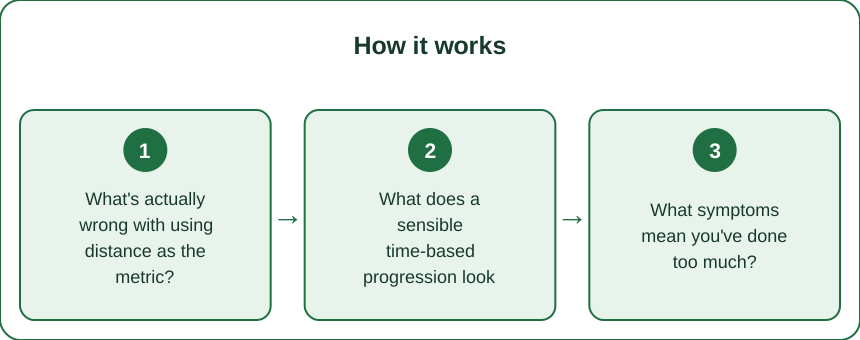
What’s actually wrong with using distance as the metric?
Distance is a measure of ground covered, not of load handled. The same two miles can vary by a wide margin in actual physiological cost depending on pace, incline, whether you’re pushing a stroller, whether you’re carrying a baby in a wrap, and how much sleep you got.
Time-based targets absorb all of those variables automatically. Twenty minutes is twenty minutes whether you’re moving slowly uphill with a stroller or briskly on flat ground — the effort self-adjusts, which is exactly what you want in a phase where capacity changes week to week and sometimes day to day.
What does a sensible time-based progression look like?
A widely used pattern is to start with short walks — often 10 minutes — and increase by roughly 10% per week, holding steady for a week whenever symptoms appear rather than pushing through.
So: 10 minutes daily for a week, then around 11-12, then 13-14, and so on. It feels almost comically slow at first and adds up faster than expected. The pace should allow full-sentence conversation. If it doesn’t, the walk is too fast regardless of duration.
What symptoms mean you’ve done too much?
The signals worth respecting are specific: increased or newly-red lochia (bleeding), a heaviness or dragging sensation in the pelvis, new leaking, or low back or pelvic pain that arrives during or after the walk.
Increased bleeding after activity is the classic signal that the progression outpaced tissue healing. These aren’t reasons to stop walking altogether — they’re reasons to return to the previous week’s duration for a week before advancing again. Persistent heaviness or leaking is a reason to see a pelvic floor physical therapist, not a reason to push harder.

Myth vs Fact: Postpartum Walking
Myth: Six weeks is a green light for normal activity. Fact: The six-week check is a clearance point, not a finish line. Connective tissue remodeling continues for months, and clearance means begin progressing, not resume prior levels.
Myth: Walking is so gentle it can’t be overdone. Fact: Walking is a sustained load on a pelvic floor that’s still recovering. It’s the right activity, but volume still matters.
Myth: Stroller walking is the same as regular walking. Fact: Pushing a stroller changes posture, adds resistance, and shifts core demand. It’s a meaningfully harder version and should be counted as such.
Myth: If it doesn’t hurt, it was fine. Fact: Pelvic floor overload frequently shows up as heaviness or bleeding changes rather than pain. Absence of pain isn’t confirmation.
How does sleep change the equation?
Sleep deprivation is not a side issue postpartum — it directly reduces tissue recovery capacity and raises perceived exertion for the same physical work. A walk that felt easy on six hours can feel genuinely taxing on three.
The practical version: on a bad night, repeat the previous week’s duration instead of advancing. Progression doesn’t have to be linear, and holding steady during a rough stretch isn’t lost ground. Consistency over months matters far more than any single week’s numbers.
FAQ: Postpartum Walking Questions, Answered
When can I start walking after birth?
Short, gentle walking is often encouraged early, but the timing and starting point differ meaningfully after a vaginal birth versus a cesarean, and after complications. This is a question for your own provider.
Does babywearing count as extra load?
Yes. Carrying the baby adds weight and changes posture and core demand, so a babywearing walk should be treated as a harder version of the same duration.
When should I see a pelvic floor physical therapist?
Leaking, heaviness, pelvic pressure, or pain that persists beyond the early weeks all warrant a referral. In many countries pelvic floor PT is routine postpartum care rather than a last resort.
TL;DR:
- Distance hides pace, terrain, carried load, and sleep — time-based targets don’t
- Start short, increase roughly 10% per week, and hold when symptoms appear
- Increased bleeding, pelvic heaviness, or new leaking mean back off, not push through
- Stroller and babywearing walks are harder versions of the same duration
- Bad sleep is a legitimate reason to repeat a week rather than advance
This is general information, not medical advice — postpartum return to activity depends on your birth, your recovery, and your provider’s guidance, and a pelvic floor PT is worth asking about regardless of how things are going.
See It in Motion
Seen here: Maternity Capris with Side Pockets — shop it on bubblelime.com
Keep Reading
This article is for general informational and styling purposes only. Fit, sizing, and product availability may vary.
