Why the Infant Car Seat Is the Heaviest Lift of Early Postpartum
Quick Answer: An infant carrier plus baby runs 18 to 30 pounds — but carried on one arm away from your body, lever mechanics multiply the effective load on your spine several times over, and the reach into a back seat adds the worst posture in lifting: bent, twisted, arms extended. You perform this lift six to ten times a day, weeks after birth, on a core and pelvic floor still under reconstruction. The fixes are mechanical and immediate: carry with two hands close to your chest or cradle it in a forearm hook, load the baby from a knee-on-seat position, exhale through every lift — and whenever possible, stop carrying the seat at all by clicking it to the stroller base or carrying only the baby.
This is general information, not medical advice — follow your own provider’s lifting guidance for your recovery.
Here is why this one object hurts more than anything else in new motherhood, and the playbook that fixes it.

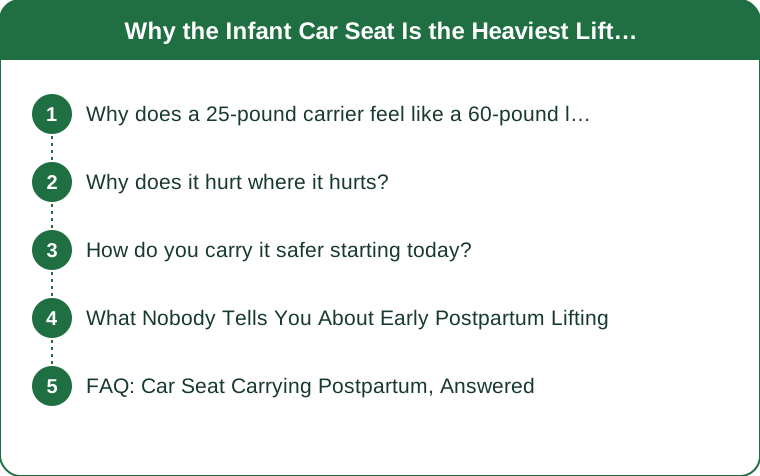
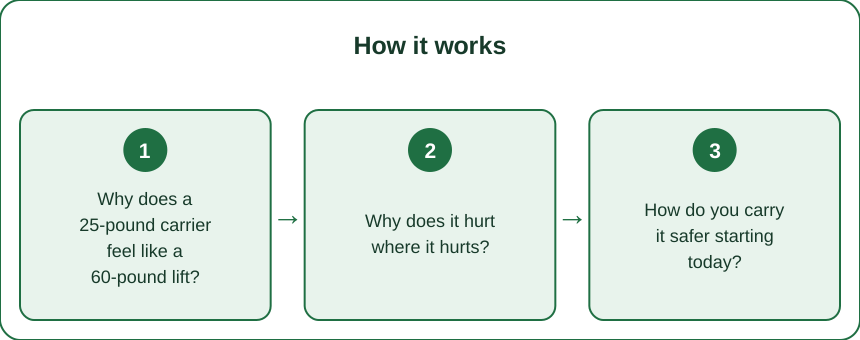
Why does a 25-pound carrier feel like a 60-pound lift?
Because of where the weight sits, not what it weighs.
Lever arms multiply load. Your spine experiences a weight according to its distance from your body: a load held at arm’s length can demand several times more back-muscle force than the same load held at your chest. The standard carrier grip — one hand on the handle, seat swinging beside your knee, torso leaning away to counterbalance — is close to the maximum-leverage, maximum-cost way to carry anything. The scale says 25; your low back is processing a number far larger.
The side-lean adds its own bill. Counterbalancing a one-sided load bends your spine sideways and works one set of hip and trunk muscles overtime — the origin of the one-sided low-back and hip ache that so many new mothers assume is just postpartum life. It is a carrying pattern, and patterns can change.
The back-seat reach is the true worst moment. Installing and retrieving the baby means bending forward, rotating, and extending your arms with the full load at maximum distance — flexion plus rotation plus load is the exact combination lifting coaches spend careers teaching people to avoid. Six to ten repetitions daily, on the timeline where your body has had the least chance to rebuild.
None of this means the carrier is unusable. It means it deserves the same respect and technique as the heaviest lift in a gym program — because for this season of life, it is.
Why does it hurt where it hurts?
The ache map follows the mechanics precisely.
Low back: the lever-arm cost lands here first. A healing core provides less of the internal bracing that normally shares the load, so spinal muscles work overtime — and eight weeks of overtime reads as that deep, constant lumbar ache.
Wrist and thumb: the carrier handle concentrates the load across one gripping hand at an awkward angle. Combined with hormone-loosened ligaments and hours of nursing-position wrist flexion, this is a main driver of the thumb-side wrist pain — de Quervain’s tenosynovitis, common enough postpartum that it is nicknamed mothers wrist. If turning a doorknob or lifting the baby palm-up produces a sharp thumb-side pain, that is the pattern, and it is worth naming to a provider early because it responds far better to early care.
Pelvic floor: every heavy, braced lift spikes intra-abdominal pressure, and the reflex most people run under load — holding their breath — sends that spike straight down onto healing tissue. Heaviness, dragging sensations, or leaking after carrier-heavy days is that pressure story being told. The single highest-value habit in this entire article: exhale through the effort — start blowing out just before the lift and keep breathing through it.
After a cesarean, the front line of the brace is the healing site itself, which argues for even stricter closeness, smaller loads, and the strategy layer below.
Pain that is sharp, worsening, or accompanied by bulging, persistent leaking, or wound concerns is a call to your provider — none of that is something to technique your way through.

How do you carry it safer starting today?
Two levels: better mechanics, and refusing the lift entirely.
Fix the carry. Hold the carrier in front with both hands on the handle, seat against your torso — close beats comfortable-looking. For one-handed moments, thread your forearm through the handle and cradle the seat against your front like a basket: the forearm hook shortens the lever dramatically and spares the wrist grip. When the side-carry is unavoidable, switch sides every trip — never let one side own the pattern. And plant the load before you walk: stand fully upright first, then move.
Fix the car moment. Open the door fully, put one knee on the seat, and bring the carrier close to your body before lifting or lowering — the knee turns a bent-and-twisted reach into a supported, close-range move. Choose the seating position by your body, not the diagram alone: curbside placement that lets you square up to the seat beats a center position you must rotate into, provided it meets installation guidance.
Refuse the lift where possible — the strategy layer. Click the carrier onto the stroller base for anything past the parking lot; the stroller carries the weight you were about to. For short trips, leave the seat installed in the car and carry only the baby — ten pounds against your chest instead of thirty at your knee. Order errands so the carrier stage is shortest, park close during this season without apologizing for it, and hand the carrier off freely: accepting the passenger seat side of the load is logistics, not weakness.
Dress for the job: supportive shoes rather than slides for loaded walks, and comfortable high-waisted leggings — the gentle, even abdominal support genuinely helps many people feel more connected through the lift, though it supplements breath and technique rather than replacing them.
What Nobody Tells You About Early Postpartum Lifting
Doorways and stairs are the real gauntlet. The carry is hardest exactly where technique dies — angling through a door, descending steps with no free hand. Rehearse those two transitions once with an empty seat and you will find your holds before the load is precious.
The seat gets heavier every single week. A newborn setup near 18 pounds becomes 28-plus by the six-month mark — the lift has a built-in progression program and your recovery timeline does not have to race it. Plan the carrier-carrying era to end: many families shift to baby-carrying, stroller-first logistics, or a convertible seat that never leaves the car well before the weight peaks.
Carries are trainable — and you are already mid-program. The gym version of this exact demand is the suitcase carry, and once your provider clears strength work, light offset carries, squats to a box, and rows rebuild precisely the capacity the car seat spends. The goal is not avoiding load forever; it is rebuilding to meet a load that is coming regardless.
A pelvic health physical therapist is the specialist for this exact intersection. Persistent heaviness, leaking, wrist pain, or an ache that outlasts technique changes is assessable and treatable — postpartum PT is standard care in much of the world, and asking for the referral is the strong move, not the defeated one.
The awkwardness is the design, not you. The handle geometry forces the load away from every body; parents of every size and fitness level report the same aches. You are not failing a normal object — you are compensating well for a badly designed lift, and now you get to compensate smarter.
FAQ: Car Seat Carrying Postpartum, Answered
When is it okay to be doing this lift at all after birth?
Follow your own provider’s guidance — clearance timelines differ by delivery and recovery. The common early rule of thumb of lifting little beyond the baby sits awkwardly beside real life logistics, which is exactly why the refuse-the-lift strategies (stroller base, baby-only carries, handoffs) matter most in the earliest weeks.
Does a cesarean change the playbook?
The principles hold and the margins tighten: keep loads closer, smaller, and rarer for longer; let the knee-on-seat car technique and the stroller do more of the work; and treat any pulling or pain at the healing site as an immediate stop signal and a provider conversation.
My wrist pain is not going away. What now?
Thumb-side wrist pain that persists past technique changes deserves a provider visit — early de Quervain’s care (bracing, activity modification, sometimes therapy referral) works far better than months of pushing through. In the meantime, the forearm-hook carry and two-handed holds spare the tendon the worst positions.
Which exercises rebuild this specific strength once I am cleared?
Suitcase carries (start light and close), goblet squats to a box, rows, and breath-led deep core work — the exhale-on-effort habit carried into every rep. A pelvic health PT or postpartum-literate trainer can sequence it to your recovery; the point is that carrier strength is absolutely rebuildable, and faster than most people expect.
This is general information, not medical advice.
TL;DR:
- Lever mechanics turn a 25-pound carrier at arm’s length into several times that load on your spine — performed ten times daily on a healing core.
- Fix the carry: two hands at the chest or forearm cradle, sides switched, exhale through every lift; fix the car with the knee-on-seat close-range move.
- Refuse the lift where possible: stroller base, baby-only carries, curbside logistics, and unapologetic handoffs.
- Wrist, back, or pelvic symptoms that outlast technique changes belong with a provider — and pelvic health PT is the specialist built for exactly this.
Before the next errand, practice the forearm cradle and the knee-on-seat move once with an empty carrier. Two minutes of rehearsal, and the heaviest lift of your day just got meaningfully lighter.
This is general information, not medical advice.
See It in Motion
Seen here: Maternity Capris with Side Pockets — shop it on bubblelime.com
Keep Reading
This article is for general informational and styling purposes only. Fit, sizing, and product availability may vary.
